

Resilience Conference in Odesa: from local needs to systemic solutions
Resilience Conference in Odesa: from local needs to systemic solutions
On 27 March, the Ukrainian Institute for International Politics held the Resilience Conference in Odesa, bringing together more than 60 participants from Odesa, Mykolaiv, and Kharkiv regions – representatives of local self-government, civil society, business, and partner organisations.
The conference continued UIIP’s work at the local level – introducing EU approaches and practices into community development. This includes strengthening the capacity of communities to work with resources, shape development policies, and take part in European programmes.
One of the conference’s central emphases was the shift from individual needs to policy-making. From isolated solutions – to integrated planning. From reacting to problems – to building a systemic vision for community development.
Entrepreneurship: business support starts with relationships
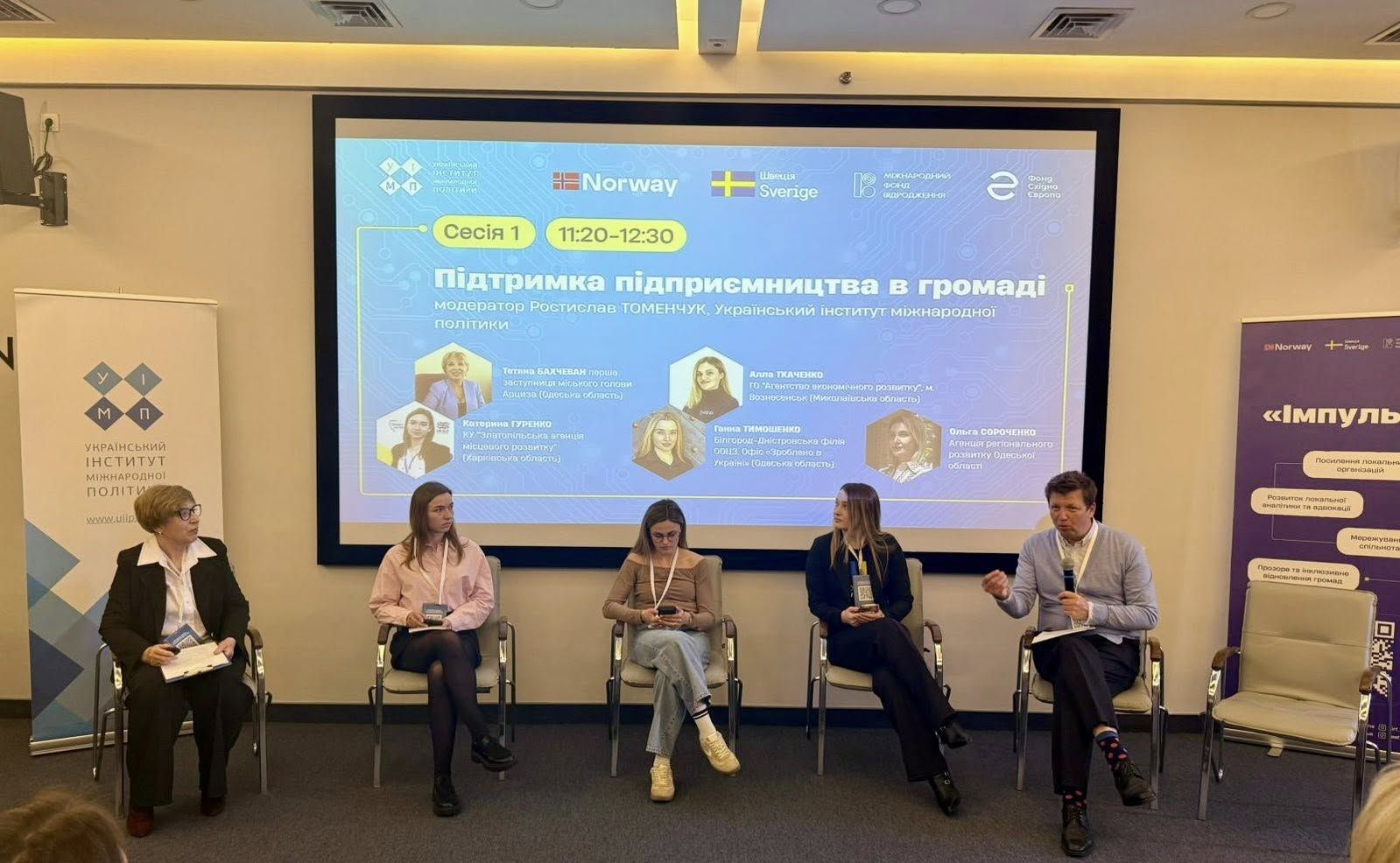
The first session focused on entrepreneurship, interaction between local authorities and business, investment, and donor support. Its main conclusion was clear: in most communities, business support has still not become systematic work.
Participants spoke about the basic elements without which no support instrument works: regular communication with business, an understanding of business needs, and an institution capable of holding this work together. For this reason, support for entrepreneurship is a matter of programmes, local capacity, and stable relationships with entrepreneurs.
Artsyz presented an approach based on using the community’s geographic potential to attract investors. Voznesensk showed another model – systematic work through support institutions, training, engagement with entrepreneurs, and an informed understanding of the local market. Participants also stressed the difference between business that needs support and business that is ready to invest in the community and strengthen its economy.
Quality of life: a condition without which a community loses people
The second session focused on quality of life and basic services. During the discussion, participants were asked where a community should allocate EUR 1 million – to the social sector or to quality of life. Most chose quality of life.
That choice reflected a practical logic. Without investment in housing, infrastructure, public spaces, safety, and services, communities lose people – especially those who are young and active. This is why participants treated quality of life as a foundation of a community’s capacity to develop.
At the same time, the real context remains difficult. Communities are supporting the Armed Forces of Ukraine, maintaining basic services, and looking for resources for repairs and network modernisation all at once. Even in these conditions, the conference highlighted examples of how investment in quality of life produces results: communities retain doctors, attract young specialists, launch new services, and find partners through cooperation with military administrations.
Waste: a matter of governance and planning
The third session focused on municipal solid waste management. A clear point emerged here: a community cannot move forward without understanding what it is working with.
The discussion started with the basics: waste morphology, mapping the organisations working in the field, available technologies, and a local waste management plan. Without this, decisions remain fragmented and do not produce a systemic result.
Participants also addressed accumulated environmental risks – including old asbestos-based materials. This showed that waste goes far beyond a коммунal? Need translate properly maybe municipal services issue. rewrite sentence simple. It is directly linked to the environmental safety of a community.
What brought all three sessions together
The conference’s final message brought all three themes together. Rostyslav Tomenchuk stressed the need to look at community development from different angles – through business, people, and the broader development picture. This is about moving from a list of problems to policies that take into account interconnections, influencing factors, and the consequences of decisions.
The same logic ran through the entire conference: in entrepreneurship – through systematic communication with business; in quality of life – through the conditions that make people stay; in waste management – through data, planning, and a community’s capacity to implement decisions.
The Resilience Conference was held with the support of the International Renaissance Foundation within the framework of the project “Impulse: Strengthening Civil Society for Ukraine’s Resilience and Recovery”, implemented with funding from Norway (Norad) and Sweden (Sida) in partnership with the East Europe Foundation.
- Hits: 723
